

~ It seemed like a good idea at the time. The family kept a small garden and a few chickens at their country home, so Dad decided that he would raise the family’s Thanksgiving turkey himself. He built a pen in the backyard and fattened up the bird on the healthiest diet of grains and water. But Dad’s dream died the moment his children named the turkey Butterball. That changed everything. Once they named him, the kids no longer saw dinner but a new friend with warmth and feelings and personality. Dad, we can’t eat Butterball! So, on Thanksgiving Day, while the family feasted on a store-bought nameless turkey, Butterball continued to reside happily in his backyard pen.
On the first day of the semester, the class is just a roster of student numbers. And some students remain only a number, they stay quietly in the background, say little in class, do nothing to distinguish themselves. But once the professor learns their names and begins to associate that name with that student’s own abilities and potential, a new, creative dynamic begins to take place between teacher and student.
We harbor some hard opinions about certain nationalities and cultures and people – until we meet someone of that ethnicity, race, religion, or orientation. You may have had that situation with someone who is Jewish or black or gay or Muslim or Mexican or Asian or American. Once you meet someone and know someone and know someone’s name, the stereotype collapses and we see a human being just like us, with the same hopes and dreams and loves as we have. Our perspective is transformed once we meet and learn another’s name. He or she is no longer a label or a number or a function or a stereotype, but a real human being.
To know another’s name is the beginning of a relationship of love and trust and responsibility. Think about how true that is in your own life. Most every relationship we have begins with learning someone’s name. Conversely, we’re embarrassed if we forget someone’s name. f we don’t know someone’s name, we don’t know them at all; but if we know them by name, that opens every door for a continued relationship.
Before he was born, the angel Gabriel told both Mary and Joseph separately that their child was to be named Jesus. In today’s Gospel on this Feast of the Lord’s Baptism, the final day of the Christmas season, the voice of God is heard identifying this Jesus as “my beloved son, with whom I am well pleased.”
Friends, on the day of our baptism, the very first question that the priest or deacon asked our parents and godparents was “What name have you given your child?” Then, when the waters of baptism were poured over us, our name is mentioned in the very same breath as the name of our God, Father, Son, and Holy Spirit. At that moment, we became a beloved daughter or son of God. We embraced the same identity as Christ. At that moment, we were named a Christian. That name has both a dignity and a responsibility.
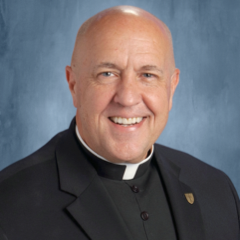
My name is John Rogers Vien. It was also my father’s name. John was my great-great grandfather’s name, Rogers was my grandmother’s name before she was married, and Vien can be traced back many generations all the way to the South of France. So I believe my name has a great dignity in that it is part of our family history. It also gives me the great responsibility to keep that family name sacred and honorable. Even if you do not have a similar history with your own name, we all have been given the name Christian, which brings great dignity and great responsibility.
We Christians have great dignity because we continue in an unbroken line stretching back over two millennia. We are family members of some of the greatest human beings this world has ever known: popes and presidents and scientists and artists. And we are sons and daughters of God, which gives us inestimable worth.
But being named a Christian also brings great responsibility, the responsibility to live up to our calling, to be like Christ; to give a good example; to be loving, forgiving, and generous; and to make sure that no one thinks less of Christians in general because of our words or actions in particular.
At the beginning of this New Year, it is fitting to ask how are you treating your name, Christian? Is it obvious to others that you are a follower of Christ, or have you retreated into anonymity, have you not given good witness, have you besmirched the name?
If you’ve not been giving good witness, if you’ve not been living up to your name, today is the day to begin again, for every baptism is a new beginning! Today at this Eucharist, and in our prayer this week, let us recommit ourselves to the work of being Christians, disciples of Jesus, disciples of justice, reconciliation, service, and love. Let us live up to the name we have been given!